

-

-
8th Largest City in India as per population
-

-
4th Fastest growing city globally
-

-
Termed as Economic Capital of Gujarat
-

-
9/10 Diamonds in the Word are cut and polished here
-

-
Ranked #4 under the Smart City Mission
-

-
Ranked #4 Swachch Survekshan 2017
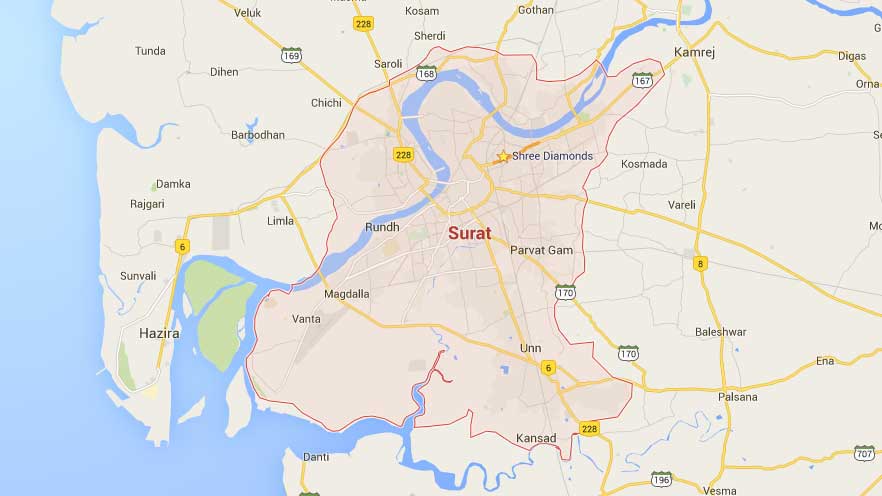
Surat is a city located on the western part of India in the state of Gujarat. It is one of the most dynamic city of India with one of the fastest growth rate due to immigration from various part of Gujarat and other states of India.
Surat is one of the cleanest city of India and is also known by several other names like “THE SILK CITY”, “THE DIAMOND CITY”, “THE GREEN CITY”, etc. It has the most vibrant present and an equally varied heritage of the past. It is the city where the British first land in India. The Dutch and the Portuguese also established there business centers in Surat, the remnants of which are still preserved in the modern day Surat. In past this was a glorious port with ships of more than 84 countries anchored in its harbour at any time.
Still today, Surat continues the same tradition as people from all around the country flock in for business and jobs. Surat has practically zero percent unemployment rate and jobs are easier to get here due to very fast development of various industries in and around Surat City.
| Surat City | 2nd largest city of Gujarat in terms of Area and Population |
| Area | 326.515 sq.km. |
| Population | 44,66,826 (Census 2011) |
| Density | 13680 Persons/Sq.Km. (Census -2011) |
| Location | Latitude : 21.112°N Longitude : 72.814°E |
| Municipality Established | 1852 AD |
| Corporation Established | 1966 AD |
History
The city of Surat has glorious history that dates back to 300 BC. The origin of the city can be traced to the old Hindu town of Suryapur during 1500 – 1520 A.D., which was later colonised by the Brigus or the King from Sauvira on the banks of River Tapi. In 1759, The British rulers took its control from the Mughals till the beginning of the 20th century.
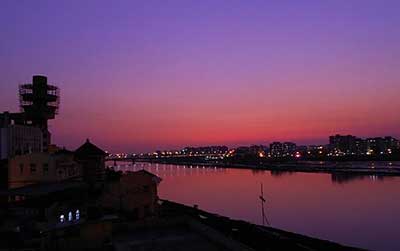
The city is located on the River Tapi and has about 6 km long coastal belt along the Arabian Sea. Due to these reasons, the city emerged as an important trade centre and enjoyed prosperity through sea trade in the 16th, 17th and 18th centuries. Surat became the most important trade link between India and many other countries and was at the height of prosperity till the rise of Bombay port in the 17th and 18th centuries. Surat was also a flourishing centre for ship building activities.
The whole coast of Tapi from Athwalines to Dumas was specially meant for ship builders who were usually Rassis. After the rise of the port at Bombay, Surat faced a severe blow and its ship building industry also declined. During the post-independence period, Surat has experienced considerable growth in industrial activities (especially textiles) along with trading activities. Concentration of these activities combined with residential developments has resulted in considerable expansion of the city limits.
Though in context of the identity of Surat in mediaeval times many views have been expressed by different historians, in all the historical narratives Surat has emerged as one of the major port of international importance on the map of the world trade. A Portuguese traveller named Barbosa during his visit to Gujarat in 1514 has described Surat as a city of great trade in all classes of merchandise, a very important seaport yielding a large revenue to the king, and frequented by many ships from Malabar and many other ports.
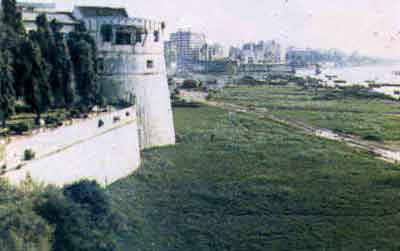
Shortly before Barbosa was in Gujarat, Surat is said to have been burnt by the Portuguese in 1512. Surat reportedly suffered from a wholly unprovoked, and piratical raid, in 1530, a second time by the Portuguese under the leadership of Antonio da Silvaria. Though the assailants were opposed by a guard of 300 horses and 10000 foot, but at the first charge the defenders fled, and the town was taken and burnt. As they were still at the war with the Gujarat King, the Portuguese again burnt Surat in the next year, 1531. The Ahmedabad king Sultan Mahmood-III (1538-1554), who was very much annoyed by these frequent destructions of Surat, ordered for building a very strong castle and entrusted the work to Safi Agha, a Turkish soldier who had been ennobled with the title of Khudawand Khan. He was provided with substantial budget and was ordered to plan and build a very strong castle. Khudawand Khan initially selected three alternative sites for building the castle
Village Tunki where presently a tomb of Marjan Shami is existing. ‘Pani ni Bhit’ area The bank of the river out of which the last alternative i.e. bank of the river was selected and finalised by the king. It has been reported that during construction stage the Portuguese made several attempts to prevent Khudawand Khan from completing the work both by bribery as well as by force failing which, they came to attack with several vessels armed with cannons, but could not succeed in preventing him from building the castle. He completed the construction of this castle in the year 1546.


